Six-part breakdown
The same six-part chart you get in your free result · sample data
Take a photo or pick one, and this attractiveness test gives you a 0–100 face score and your face shape in seconds. Free test: nothing uploaded, no sign-up.

77/100
Strong proportions
Oval face shape

87/100
Standout balance
Oblong face shape
Free. It runs in your browser and your photo is not uploaded. A selfie takes 3 shots and averages them, so your score doesn’t jump around. Free tests have no limit. View report pricing
No new photo needed: the next test uses this one’s numbers, kept on this device for up to a day.
The selfie is guided and takes three shots. If you choose photos from your library, you can pick up to three of the same face, and the result says how many it used.
Light, angle and distance are checked before it shoots.
Each shot is measured, then the measurements are averaged, so a frame with a blink or a small head movement is only a third of what is measured.
Turned more than about 9°, symmetry is left out; tipped up or down more than about 11°, facial thirds are. The result names what was left out.
Every measurement explained in plain words, with seven areas of the face scored.
Hairstyles and a styling preview tried on your own photo.
An action plan covering styling, grooming, everyday skincare basics, posture and photo habits. Nothing medical, no procedures.
The same six-part chart you get in your free result · sample data
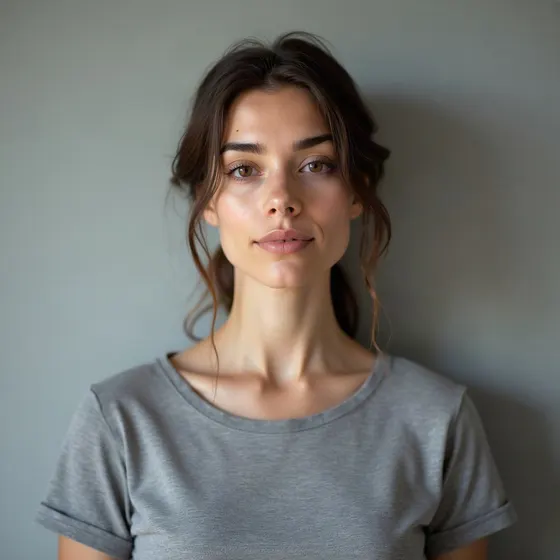
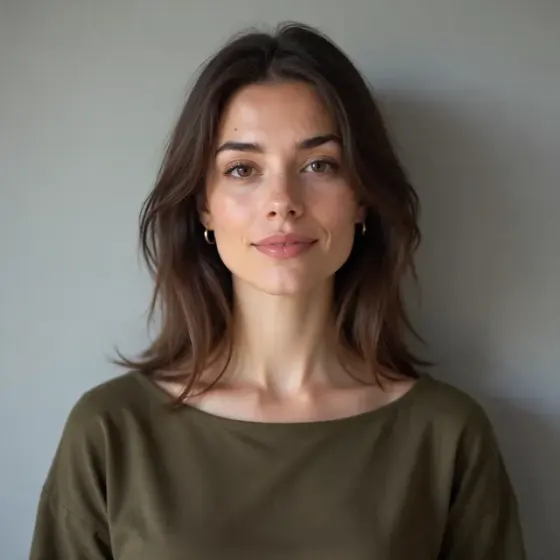


Styling preview – hair, grooming or makeup, and clothes on the same photo. It shows a look, not a change to your facial structure; small details can still shift. AI-generated sample faces, not real people.
$15.99 · one-time · web report + PDF · not a subscription
Get my full report – $15.997-day refund: not happy? Email us within 7 days of buying for a full refund.
Read a complete sample reportIn the report · drag the line to compare
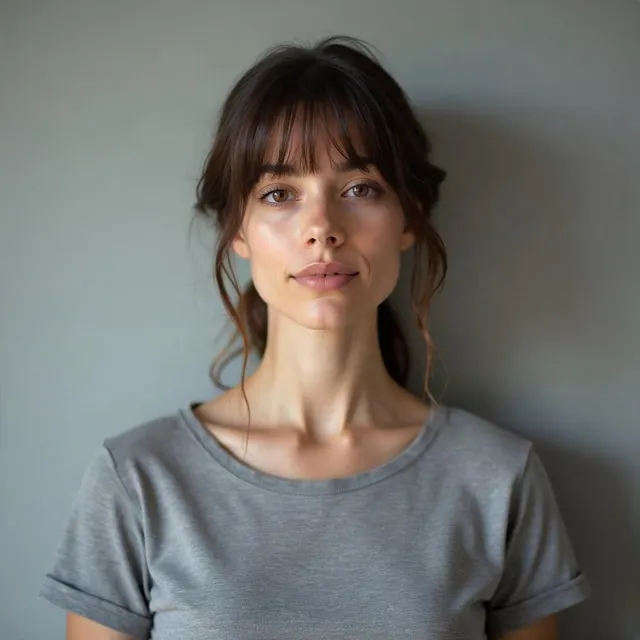
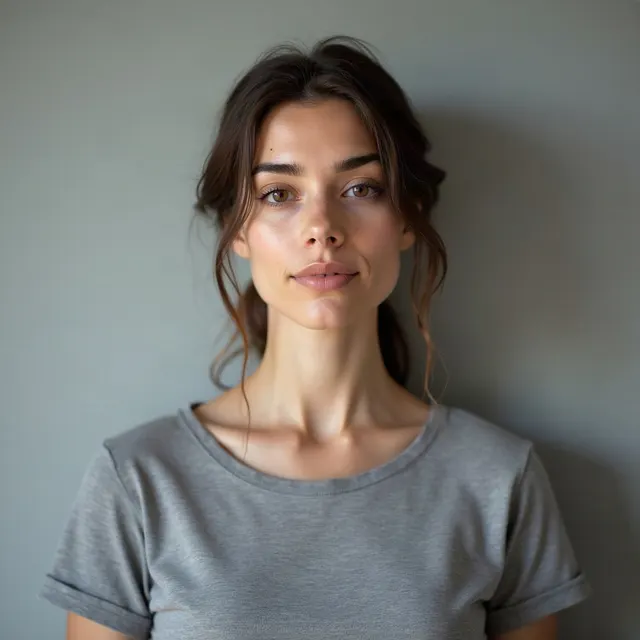
The sample photo with its hairstyle changed by AI, using the same instruction the report uses. Small details of the face can shift. It shows styling only; it is not a prediction of how your face could change.
The test finds 478 points on your face and turns them into more than 50 measurements: how the face divides top to bottom and side to side, how closely the left and right sides mirror each other, the angle of the eyes, the width of the jaw next to the cheekbones, and a set of ratios that people like to compare with the golden ratio. The score uses proportions and angles. Choose a clear photo where your face is large enough to see both eyes.
It does not look at skin, hair, teeth, weight, age, style or expression, and it knows nothing about your voice, your humour or how you treat people. It is a face rating of geometry in one photo. That is a real thing to measure and a small part of how anyone looks.
The score has six parts, and the weights are fixed: symmetry 25%, facial thirds 15%, facial fifths 15%, golden ratio 10%, eye area 20%, jawline 15%. Each part is the plain average of its measurements. Tap any part in your result to see the numbers behind it.
Each measurement is scored from 40 to 100 against a reference range, shown beside your number as “full marks”. Inside the range it scores 100; outside, it loses points in a straight line until it reaches the floor of 40. Because every measurement has that floor, the lowest total the test can give is 40, not 0: the scale is 0–100, and the bottom of it is never used on purpose, since one photo cannot justify a lower number. Symmetry works the other way round: the smaller the difference between the two sides, the higher the score. The golden ratio measurements score 100 within 3% of 1.618 and reach the floor at 30% away.
Two rules cover uploaded photos taken at an angle. If the face is turned to one side by more than about 9 degrees, symmetry is left out: a turn makes the two sides look less alike than they are. If the head is tipped up or down by more than about 11 degrees, facial thirds are left out: a tip stretches one end of the face and squeezes the other. A part that is left out is shown as “not scored”, the total is marked (for example “without symmetry”), and the remaining parts keep their proportions and are scaled up to make 100%. Without symmetry that is facial thirds 20%, facial fifths 20%, golden ratio 13.3%, eye area 26.7%, jawline 20%; without facial thirds it is symmetry 29.4%, facial fifths 17.6%, golden ratio 11.8%, eye area 23.5%, jawline 17.6%; with both left out it is facial fifths 25%, golden ratio 16.7%, eye area 33.3%, jawline 25%. A straight-on photo, or the guided selfie, which only shoots when you face the camera squarely, includes everything.
The reference ranges are this test’s own. They come from running the same landmark model over a calibration set of a few dozen computer-generated, front-facing faces and taking the middle of each measurement. They are not statistics about real populations, and they are not a beauty standard; they are a fixed yardstick, published so you can see what you are being compared with.
There is no randomness and no hidden adjustment. The same photo on the same device gives the same score every time.
Most of the difference between two scores for the same person is the photo, not the face. The guided selfie checks these for you and will not shoot until they pass:
A higher score means your proportions in this photo sit closer to the reference ranges and your two sides match more closely. It does not mean more attractive in any final sense. Faces that people find striking often sit well outside the middle on some measurement, and ideas of beauty differ between cultures, decades and individual people.
A lower score is not a flaw to fix. It usually means one or two measurements are unusual, or that the photo was taken from a little above, below or to the side. If a number here ever makes you feel worse about yourself, close the tab: it is a ruler held up to a picture, nothing more.
The free test gives you the 0–100 score, a named tier, your face shape, all six parts with the measurements inside them, the photo with the measuring lines drawn on it, and a share card. It needs no account.
The complete report explains every measurement in plain words, scores seven areas of the face, reads your apparent age, skin and colour season from your photo, and adds an action plan and AI pictures on your photo. It is a one-time purchase of $15.99, not a subscription, and the button in your result shows a preview built from your own test before you pay.
The free test runs entirely in your browser. The landmark model is downloaded to your device, your photo is measured there, and the photo and the measurements are not sent to our servers. The share card is drawn on your device too, and it goes nowhere unless you save or send it yourself.
People arrive here typing “am I pretty”, “am I attractive” or “how attractive am I”, and a number feels like it should settle it. It can’t, and no face rater can. What a test like this can honestly tell you is narrower and still interesting: how balanced your proportions are, which features stand out, and what shape your face is.
Use it the way you would use a pretty scale quiz with a friend: for curiosity, for choosing a haircut or glasses that suit your face shape, or for seeing how much lighting changes a photo. For the question underneath, the people who know you are a better mirror than any face analysis.
Yes. The score, face shape, six-part breakdown and share card are free, with no account and no limit on how often you test.
No. The free test measures your photo inside your browser, and the photo and measurements are not sent to our servers.
It measures proportions consistently; it cannot measure attractiveness itself. The formula is fixed and published, and the same photo always gives the same score, but a different photo of the same face (other light, angle or expression) can move the result by a few points.
Because each photo is slightly different. The same photo always gives the same score on the same device; a new selfie has a new angle, light and expression. The 3-shot selfie in good light is the steadiest way to test.
There is no pass mark. On the computer-generated faces this test was calibrated with, scores ran from 66 to 92 with a middle of 81, so a result in the 70s or 80s is ordinary, not a warning.
Yes. Choose a photo instead of taking a selfie. It needs one face, looking straight at the camera, evenly lit and not too small in the frame; the test tells you if it can’t be measured and why.
You can take the free test without an account. Adults can sign in to claim their first free AI image while trial images are available; buying a report or an image pack also needs an account.
Every measurement explained in plain words, scores for seven areas of the face, your strongest features, your apparent age and skin, your colour season, faces with features like yours, makeup and grooming tips, an action plan with a four-week schedule, 7 AI pictures on your photo (hairstyles matched to your face and a best-look preview) and a PDF download.
The test is free and there is no subscription. The complete report is a one-time purchase of $15.99.
Yes, with a webcam or an uploaded photo. A phone held at eye level usually gives a steadier result than a laptop camera looking up at you.
Pricing checked
Free, in your browser, with no sign-up.